• Home
  • About Us
    • Mission Statement
    • History
    • Staff Bios
    • Board List
    • Financial Report
    • Latest News
  • What We Do
    • Program Overview
    • Effectiveness/Impact
    • Parent Testimonials
  • Get Involved
    • Volunteer Opportunities
    • Partner Schools
    • Donate Now
    • Job Opportunities
  • Parents & Students
    • How to Apply
    • GO Application
    • Student Events
    • Resources
    • Image Gallery
  • Events/Workshops
    • Annual Benefit
    • Tours
    • Special Events
  • Contact
banner2.jpg

Help us continue to shape academic futures

Latest News

  • Workshops
  • SPOTLIGHT: GO CONNECT, NEW MENTORING PROGRAM
  • The GO Project social work staff push into public schools
  • Job Opportunities
  • Help

Teacher's Login

  • Forgot your password?
  • Forgot your username?
If you do not know your username or password please email info@goprojectnyc.org.

News

SPOTLIGHT: GO CONNECT, NEW MENTORING PROGRAM

Last year, the GO Project piloted a mentoring program, called GO Connect, meant to help students develop an enriching relationship with an adult to help build their confidence and the skills to grow academically, emotionally and socially. This year, thanks to a generous $10,000 grant provided through the Lang Opportunity Project in conjunction with Swarthmore College student, Ashia Troiano, the GO Project was able to continue and expand the mentoring program.

Jori Howard, Co-coordinator of GO Connect, swears by the importance of developing solid relationships between children and adults. “Research has proven that students who engage in a one-on-one relationship with a caring adult show improvement in their grades, have increased self-esteem and social skills, and maintain a greater level of confidence in completing tasks,” Howard noted. “Having had many mentors in my own life, I can attest to the accuracy of that research and find that the population we currently work with would all benefit from having a mentor in some form.”

Many students at the GO Project come from either single parent or working parent families where positive interactions between children and adults may be lacking. Even in families where parents are actively involved, mentoring does not need to take away from these family relationships, but adds another person to the child's life who the child can look up to and from whom they can receive encouragement.

There are currently 17 pairings of mentors and mentees. The goal is to reach 25 matches by the end of this year. These matches are made with utmost care and consideration for the child’s needs and personality. “Matches are made after interviews with the parent, teacher and mentor. Once each party gives their input, Martine, Director of Programs, and I sit down and try to figure out who would be best matched,” Howard explained.

The selection of mentors also undergoes a rigorous review process to ensure safety for our students and a productive experience for our mentors. Howard describes the process, “First, prospective mentors must set up to be interviewed by Martine or myself where questions are asked to gauge their suitability for mentoring. After that, they sign up to attend an orientation and training session where a more detailed screening process takes place, allowing us to see the prospective mentors in social interactions and role plays. After they have attended both the orientation and training, they fill out a background check, a liability form provided by Swarthmore College, and supply us with personal references to call.”

When asked what GO Connect’s “value-added” was, Howard was adamant in her response. “The mentoring component adds a social dynamic that can't be reached in small group instruction or a tutoring session.


GO Connect gives each child the idea that they matter, that they are worth someone's time and worthy to be loved. It teaches them that they are special and can do great things. It also teaches them, through modeling during cooperative games, how to play fair, be a part of a team, lose graciously and win humbly.”

Each mentoring session begins with group work using a curriculum piece focused on topics such as conflict resolution, diversity, college and careers, embracing green, taking care of me, movement and the arts. Afterwards, the matches either engage in free time where they get to speak one to one, play games with other matches developing deeper relationships and modeling appropriate social interactions, or participate in a cooperative game where they get to compete as individuals or in groups in some physical activity tied into the curriculum.”

In addition to this, the matches will also get to take field trips to Columbia University, the Ecology Recycling Center, as well as participate in community service in a local park. The matches will also have guest artists In-Sight Dance Company and Natalie Wood of Lehman College Graduate School lead a class and do a demonstration of their art.

The program is clearly a hit with the students, the parents, and the mentors. Howard recounts that, “On one occasion, a GO Project parent spoke so highly of the program that a non-GO Project parent called the office asking for her child to be in our mentoring program. We explained that her child had to be in the GO Project to be part of GO Connect. Her next question was where does she sign up?!”

The mentor-mentee relationships grow throughout the program to form enriching experiences for both parties. Howard recounts how a mentor has been wanting to be a mentor for years, but because of his active duty status in the military, he was never able to make the commitment. He said that he was most grateful that the GO Project was able to make this experience finally happen for him. He will be back on active duty in May, after his match is closed. He has been a valuable addition to the mentoring program and his match could not be happier building a friendship with a real military soldier.

The mentors come from diverse backgrounds. They are teachers, parents, advertising executives, graduate students, military personnel, accountants, college admission counselors and performing artists. GO Connect is growing and new mentors are always needed in order to engage more students and form more rich and rewarding relationships.

If you are interested in becoming a GO Connect mentor, or would prefer to be a weekday or Saturday tutor, please email This e-mail address is being protected from spambots. You need JavaScript enabled to view it or call 212.533.3744 to speak with Martine King, Director of Programs.


The GO Project social work staff push into public schools

THE GO PROJECT SOCIAL WORK STAFF PUSH INTO PUBLIC SCHOOLS

The GO Project is actively expanding our network of masters student social work interns from the Silver School of Social Work at NYU to push into our partner public schools. The goal is to provide social and emotional support to GO Project students who would benefit the most from additional attention, and to maintain the support through more regular contact throughout the week.

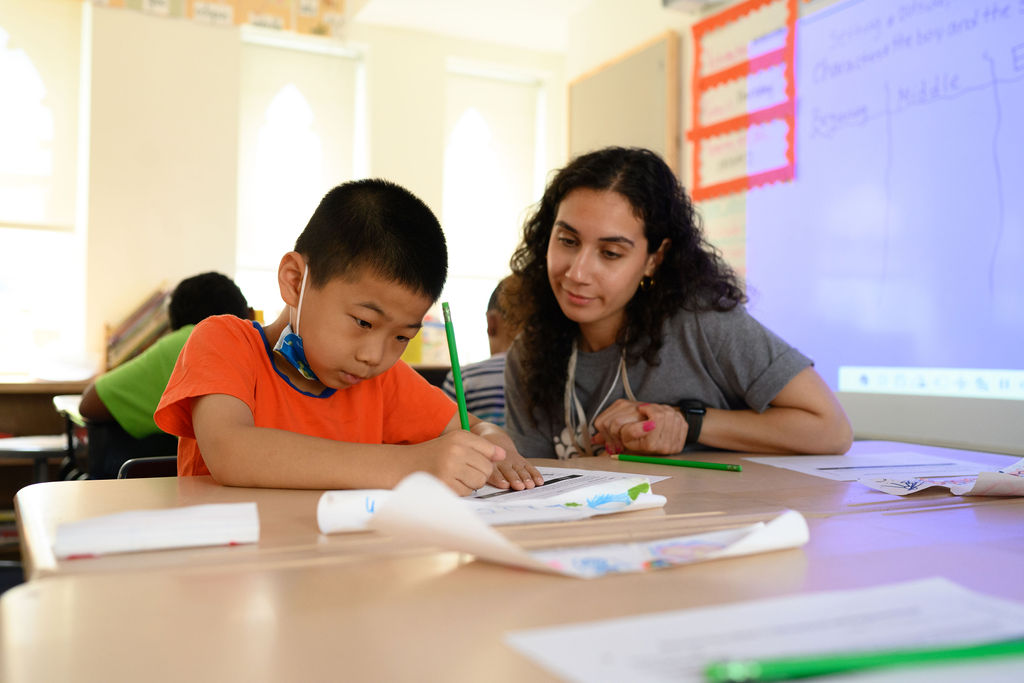
The GO Project currently has seven interns who each work closely with the school’s administrators to target the students’ areas of concern. Public schools are selected to receive social work intern placement based on the number of their students that attend the GO Project and the amount of benefit to the students. The interns work with students either individually or in small groups.

Having social work interns placed inside our partner schools creates a link  between Saturdays to help the GO Project staff understand and address issues that may come up during the week that may affect performance in class on Saturdays.

“The kids we work with are often too young to know why they are struggling in school, either with their confidence or their ability to focus, for instance. When we are able to provide them more attention in their school, we can get a sense of what might be holding them back and can help them work on it,” GO Project intern, Chrisitna Hunkins, said.

Rachel Kolodin, another intern, also feels strongly that intervention during the week is vital to provide consistency for the students. She does play therapy, as well as family and parent counseling, at PS 64.

“Having GO Project social work interns in the school is so important for the children, parents, and school staff. In the school we are given a much greater ability to address the children's issues on a more regular basis and focus on the problems at hand holistically. In the school environment, we are given the opportunity to see their interaction with other children and their teachers, and can handle issues as they arise,” Kolodin explained.

The goal is to both provide comprehensive support to the students who need it most, and to create lasting relationships with schools. Stronger partnerships with individual schools will ultimately allow the GO Project to be the go-to resource for children who are both academically underperforming and who may not have access to other services due to their family’s financial situation.

The response from partner schools has been very positive so far. At PS 64, Kolodin notes that “the principal is very grateful that we are in the school, and the guidance counselor has been a wonderful source of help.”

Additionally, the interns gain valuable firsthand experience and guidance from the GO Project’s Director of Social Services, Diana Gasperoni, who meets with each intern weekly to discuss strategies to work with their students.

“The GO Project is an ideal placement for a social work intern because of the combination of clinical practice, referral skills and a broader sense of the community that it provides. It allows me to apply directly what I’m learning in my classes. The GO Project provides a much more well-rounded experience than many other agencies can offer their interns,” says Hunkins.

 
  • Site Map
  • Search
  • Help
  • Admin

The GO Project, Inc. is a 501(c)3 non-profit organization. All charitable gifts are tax deductible to the full extent allowed by law.
© Copyright 2009 The GO Project. All Rights Reserved.
86 Fourth Avenue New York, NY 10003